How Many LLCs Does Your Farm Need?
One of the questions I get most often from farm owners is: “Do I really need more than one LLC?”
Most people assume one LLC is enough. That’s usually not true.
Why It Matters
LLCs aren’t just paperwork. They separate the liability of each business.
This makes each operation less attractive to plaintiffs and their attorneys. If one part of your farm faces a lawsuit, the rest of the farm isn’t automatically on the hook. Each business becomes its own target — smaller, contained, and with less assets to acquire in a potential lawsuit.
Land Matters
A simple starting point: one LLC for each piece of land you use for business.
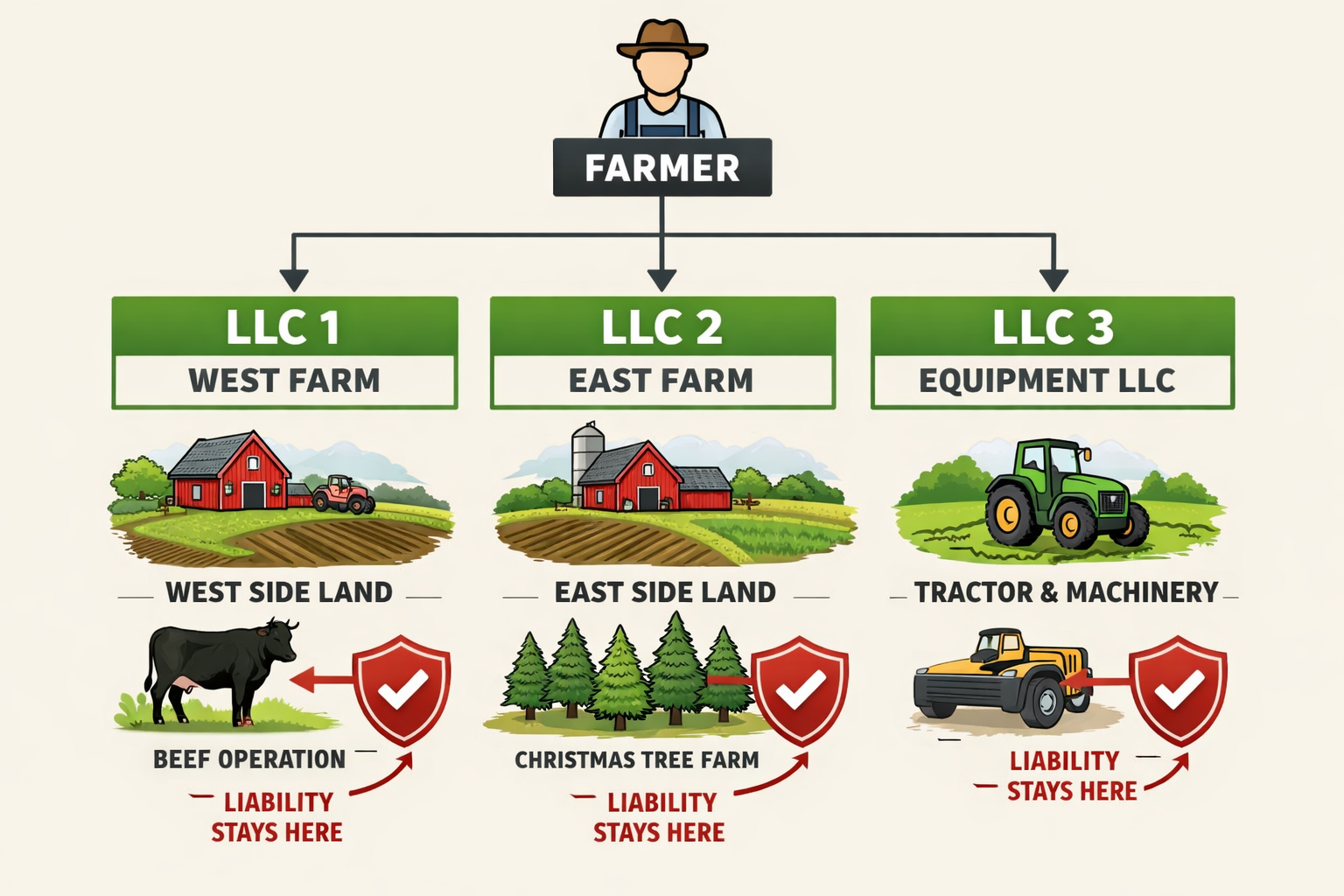
For example, imagine a farmer who owns land on the east side of the county and more land on the west side. If all that land is in one LLC and something goes wrong on the east-side property — say a machinery accident or a contract dispute — the west-side property could also be at risk.
Separating them into different LLCs keeps one parcel from jeopardizing the other. In other words, assuming each property is in its own LLC, an accident that occurs on Eastside LLC’s property will not endanger the property owned by Westside LLC.
Different Businesses, Different LLCs
It’s not just about land. Different farm businesses carry very different risks.
For example, imagine a farmer who runs a beef cattle operation and also owns a Christmas tree farm. The cattle operation involves risks like livestock injuries, veterinary claims, or liability if someone is hurt while working around the herd. The Christmas tree farm, on the other hand, brings customer traffic, seasonal employees, equipment use, and the possibility of slip-and-fall injuries or property damage during peak season.
If both operations are held in the same LLC and something goes wrong at the Christmas tree farm (e.g., a slip and fall) the cattle operation and its assets could also be exposed. Separating each business into its own LLC helps ensure that a problem in one operation does not jeopardize the other.
Holding Companies Add Another Layer
Once a farm grows to include multiple LLCs, a holding company can be a useful next step.
For example, imagine a farm family that owns three separate operating LLCs: one for cotton production, one for a cow-calf operation, and one for a you-pick blueberry farm. The family also forms a holding company that owns all of the farmland. Each operating LLC rents the land it uses from the holding company under a written lease, just like any other farm lease. The holding company does not plant cotton, manage cattle, or host customers. It simply owns the land and collects rent.
This structure keeps land ownership separate from the day-to-day businesses. If a problem comes up at the you-pick blueberry farm — for example, a customer gets sick after eating blueberry ice cream sold on-site — the issue stays with the blueberry LLC. In practical terms, the only things at risk in that company are a small operating bank account that receives sales income, pays rent to the land-holding company, and sends a good bit of the rest to the farmer as owner payments. There is no land and no major equipment sitting in that LLC, which makes it a much smaller target if something goes wrong.
Holding companies are not necessary for every farm, but for larger operations with multiple parcels or different types of businesses, this setup can make it easier to add new ventures, keep assets organized, and add an extra layer of protection.
Take Action
Start by separating LLCs by land and by business activity. That way, the things that can’t easily be replaced — like land — are not exposed to the everyday risks that come with running a farm business. It’s a simple structure, but it does real work.
I share more examples like this on my social media channels, focused on practical steps farmers can take before a problem ever shows up.
If this way of thinking makes sense to you, send me a message through my website. I can help you walk through whether this type of structure fits your operation and where it may or may not be worth the added complexity.